
Italy's flat-rate regime (forfettario) explained
The regime forfettario is Italy's simplified tax scheme for individuals with a partita IVA, set by Law 190/2014. You don't pay income tax, regional surcharges or IRAP on your actual profit: you multiply your revenue by a coefficient fixed for your ATECO code, deduct your pension contributions, and pay a single 15% substitute tax on the result. You charge no VAT and cannot reclaim VAT on purchases, and clients don't withhold tax on your fees. In exchange you still invoice electronically through SDI and pay a 2 € stamp on most invoices.
Who has to comply
It suits individuals running a business or profession whose revenue last year stayed within 85,000 €. You also need to have spent no more than 20,000 € on staff and collaborators, and your employment income in the previous year must not exceed 30,000 €, raised to 35,000 € for 2025 and 2026. If you pass 100,000 € during the year, the regime ends that same year.
Key dates
- 1 Jan 2015The flat-rate regime of Law 190/2014 comes into force for individual VAT holders.
- 1 Jan 2016New activities pay 5% instead of 15% for their first five years, under conditions.
- 1 Jul 2022Flat-rate taxpayers with over 25,000 € of revenue in the previous year must issue e-invoices via SDI.
- 1 Jan 2023The revenue ceiling rises from 65,000 € to 85,000 €, with immediate exit above 100,000 €.
- 1 Jan 2024E-invoicing through SDI becomes mandatory for every flat-rate taxpayer, whatever their revenue.
Tools that support it

Fatture in Cloud fills in the flat-rate fields and 0% VAT, adds the 2 € stamp above 77.47 € and warns you as you near 85,000 €.

Aruba lets you set the RF19 regime and the no-withholding wording on every invoice, and can add the 2 € stamp automatically. We found no revenue tracker for the 85,000 € limit.

Qonto's invoicing, included in its business account, sends forfettario invoices through SDI and handles the 2 € stamp; you pay the stamp from the account or by F24.

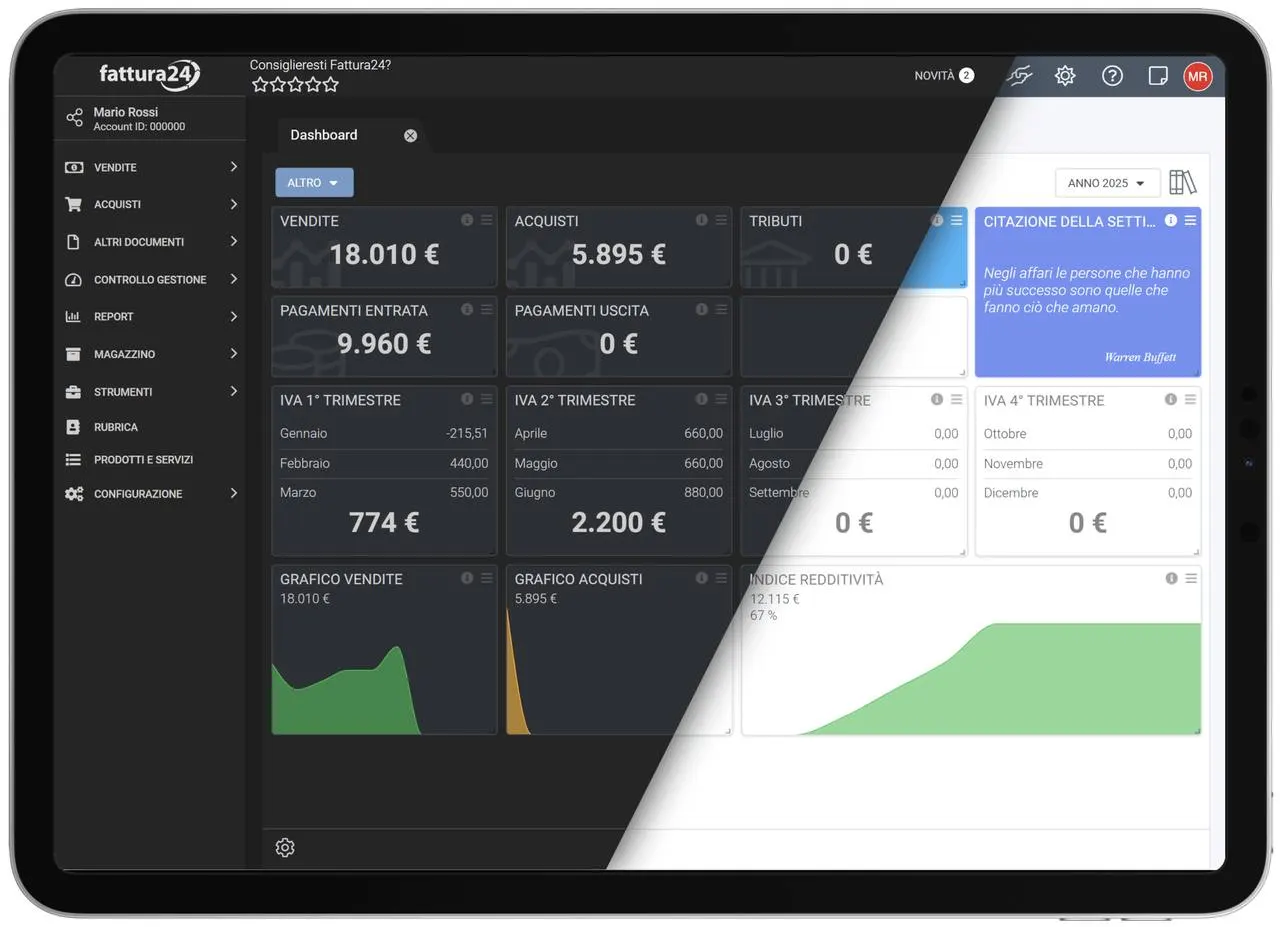
Fattura24 lists the forfettario regime on every plan and adds the 2 € stamp above 77.47 € once you set it in your tax profile; it asks before applying it.

Hype Business is an account for forfettari: its Tax Manager sets aside an estimate of taxes and contributions and F24 is free, but it doesn't issue invoices.
Questions
How much tax do I pay on the flat-rate regime?
Take your revenue, multiply it by your activity's coefficient, subtract the pension contributions you paid, and apply 15%. Most professional activities (ATECO groups such as 69 to 75) use a 78% coefficient, so on 40,000 € of fees your taxable base is 31,200 € before contributions. At 15% that is 4,680 €, or 1,560 € if you qualify for the 5% start-up rate. Shops and restaurants use 40% and construction or real estate 86%, so the same revenue gives very different bills.
What happens if I go over 85,000 €?
Between 85,000 € and 100,000 € you stay in the regime for the rest of that year and move to the ordinary regime from the next one. Above 100,000 € the regime ends in the same year. The Agenzia delle Entrate says the payment that takes you past 100,000 € is the line: from that operation on you charge VAT and follow ordinary rules. Track your income as you collect it, because the limits count cash received, not invoices issued.
Who gets the 5% rate for the first five years?
Law 190/2014 gives 5% for the year you start and the four after it. You must not have run a business, profession or artistic activity in the three years before, alone or with others. The new activity cannot be a mere continuation of a job you did as an employee or freelancer, though a compulsory traineeship does not count against you. If you take over someone else's business, its revenue in the previous year must be within 85,000 €.
What goes on a flat-rate invoice?
You charge no VAT, so the e-invoice carries regime code RF19 and VAT nature N2.2 instead of a rate. You add a line saying the operation is not subject to withholding tax under Law 190/2014, article 1, paragraph 67. If the total is above 77.47 €, you add a 2 € stamp duty that you then pay to the Agenzia every quarter, with an F24 or from its portal. Many invoicing apps fill these fields once you set your tax regime.
Who cannot use the flat-rate regime?
You are out if you use special VAT schemes, or if you live outside the EU or EEA and earn less than 75% of your income in Italy. Mainly selling buildings, land or new vehicles to other EU countries also excludes you. So does holding a stake in a partnership, a professional association or a tax-transparent limited company. Employment income above the yearly limit (30,000 €, or 35,000 € in 2025 and 2026) closes the door too, unless that job ended during the year.
Official sources
- Agenzia delle Entrate: regime forfetario, che cos'è
- Agenzia delle Entrate: regime forfettario, requisiti e cause di esclusione
- Agenzia delle Entrate: regime forfettario, reddito e tassazione
- Agenzia delle Entrate: legge 190/2014, articolo 1, commi 54-89
- Agenzia delle Entrate: legge 190/2014, allegato 4 (coefficienti di redditività per codice ATECO)
- Agenzia delle Entrate: l'imposta di bollo sulle fatture elettroniche
- Normattiva: decreto-legge 30 aprile 2022, n. 36, articolo 18